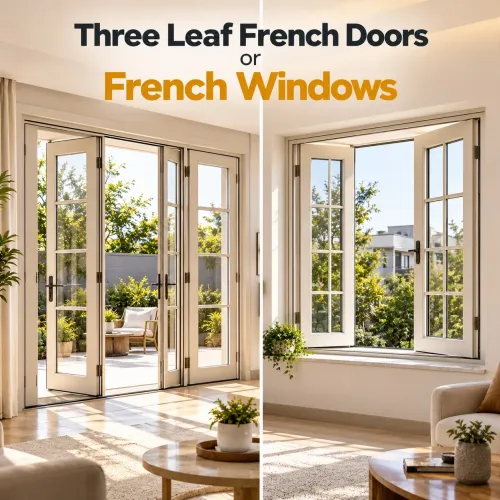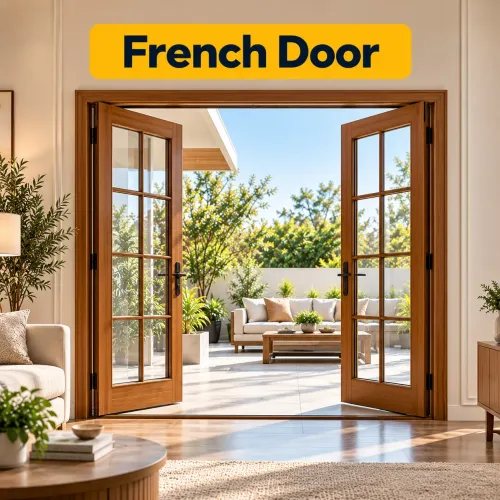
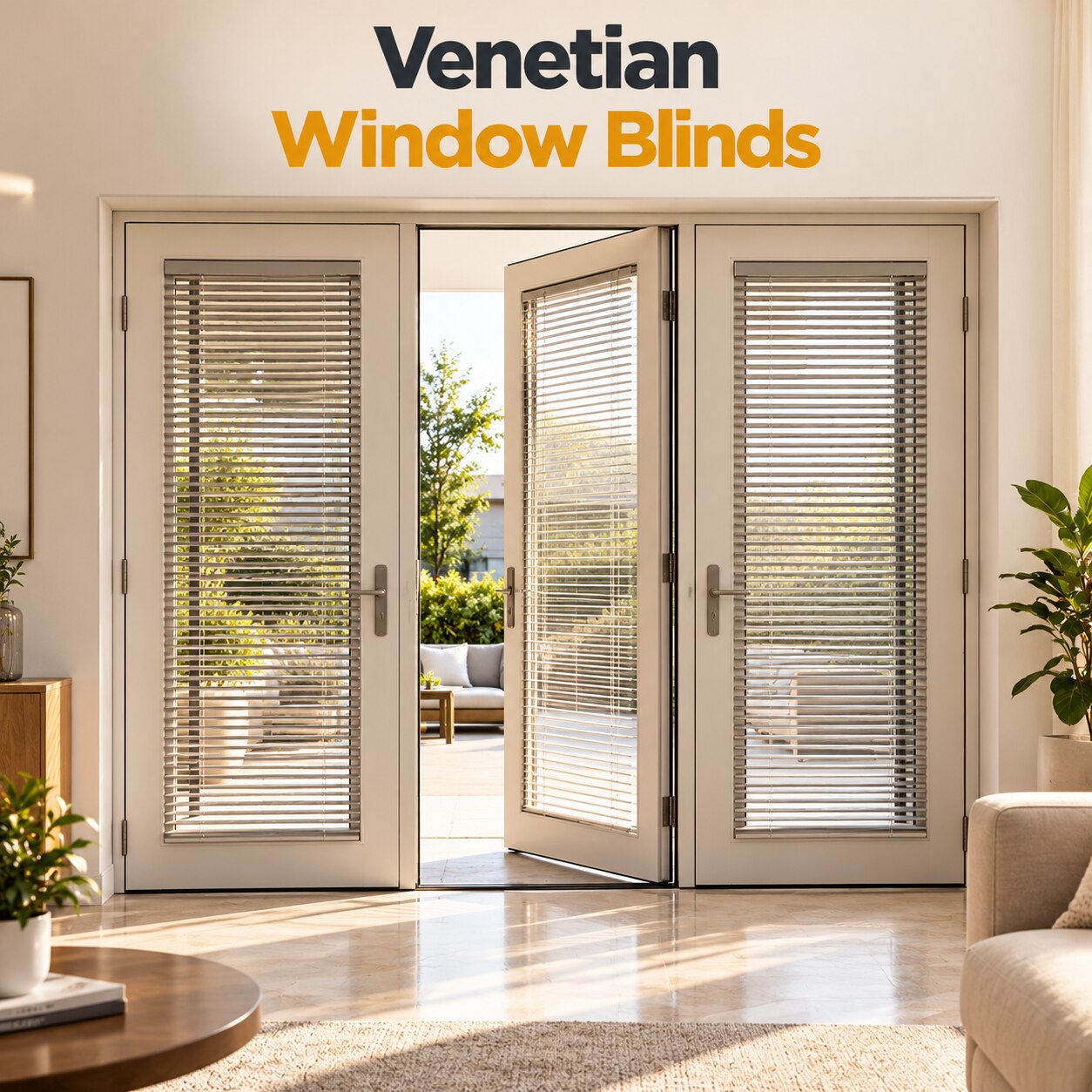
Yes, but the workable design is usually three separately fitted blinds rather than one covering across the entire doorway. You will be able to measure each leaf, compare blind materials, check operating clearances and specify an installation that remains secure when the doors open.
Key takeaways
- Use one separately operated blind for each door leaf.
- Measure each glass leaf, not the full three-leaf opening.
- Check slat swing, handles and meeting-stile clearance before ordering.
- Approve operation, alignment and fixing quality at installation handover.
Why Three Separate Blinds Usually Work Better Than One Wide Blind
Venetian blinds can suit a three-leaf French door, but one wide blind rarely makes practical sense. The usual arrangement is one separately operated blind on each leaf, because each door can move without dragging a heavy, continuous covering across the meeting stiles.
| Option | Appearance and weight | Handling, privacy and access |
|---|---|---|
| One wide blind | Gives a single uninterrupted look, but its width adds weight and increases the risk of sagging | One leaf cannot open independently; moving the blind affects all three sections and can block handles |
| Three separate blinds | Creates three clear vertical sections that align with the door leaves | You can open one leaf, adjust privacy on one section and reach its handle while the other two remain covered |
| Matched blinds with different use | Keeps the elevation visually balanced even when one leaf is fixed | The fixed leaf needs appearance matching; active leaves need the closest checks for movement and restraint |
A continuous blind can cover the meeting stiles, strike an adjacent leaf or prevent access to one handle unless the entire blind is raised. Three leaf door blinds avoid that compromise, provided each blind clears its own handle, hinges, lock furniture and neighbouring leaf in both raised and lowered positions.
Do not specify blinds for French doors from the total glazed opening alone. Specify them around door movement. Test every blind leaf by leaf: raise, lower and tilt it, operate the handle and lock, then open each active leaf fully.
A normally fixed leaf may use a matching blind, while active leaves require the most careful collision and bottom-restraint checks.
Measure Each Leaf Instead of Ordering to the Overall Door Opening
A catalogue door size is not a blind size. For Venetian window blinds for three-leaf French doors, measure each moving leaf separately; one leaf must not automatically become the template for the other two.
1. Record the glass width and glass height on the left, centre and right leaves. Measure each at the top, middle and bottom, then use the smallest usable width where the blind must sit inside a recess.
2. Measure the sash or frame width, available recess depth and headroom above the glass. Mark the position of every glazing bead, because a bead that sits proud can reduce the space available for the headrail.
3. Check the handle projection, lock position, hinge-side clearance and both meeting-stile widths. Record the central meeting gap and the position of each weather seal; a projecting headrail or slat can foul the adjacent leaf when the doors open.
4. Measure the threshold height and the lowest point the blind could reach, especially where a leaf swings over a raised sill. Check the fully opened position, not only the closed doors.
5. Give the installer glass measurements separately from the finished blind measurements. The finished size must allow for brackets, headrail depth, operating clearance and any required gap around the frame.
Frames and plaster vary across one opening. Ask for three finished widths and three drops on the order, rather than one nominal opening measurement.
Choose the Blind Material, Slat Width and Mounting Position
Aluminium is the safest practical choice for a moving exterior door exposed to damp air, cleaning water or monsoon humidity. For Venetian window blinds in Nashik, it avoids the swelling associated with untreated wood, but material limits still matter.
| Material | Strength | Check before ordering |
|---|---|---|
| Aluminium | Handles humidity and splashes without swelling like untreated wood | Confirm the finish and hardware suit exterior-door use |
| PVC or moisture-resistant faux wood | Suitable where the product is rated for moisture | Read the manufacturer’s stated moisture limit |
| Real wood | Attractive, but vulnerable to moisture-related movement | Do not assume every Venetian material tolerates humidity equally |
Choose narrow slats when the sash is tight or the handle and meeting stile leave little projection space. Wider slats give a stronger visual proportion, but their headrail, tilt mechanism and stack need more clearance around handles and the central gap.
An inside mount works only when the recess is deep and clear enough for the headrail and slats. If glass sits close to the door face or glazing beads leave a shallow pocket, use an outside or door-face mount instead.
- Fix brackets to the door frame or a manufacturer-approved mounting surface.
- Never attach brackets to the glass.
- Check the fully opened door, not just the closed position, because a projecting blind can strike the neighbouring leaf or meeting stile.
Control Swinging Slats, Handles and Meeting-Stile Collisions
A door-mounted blind needs restraint at the bottom, or draughts can make its slats strike the wall, handle or neighbouring leaf. Use hold-down brackets, magnetic catches, side guides or another manufacturer-approved restraint; vibration can otherwise loosen fixings, create noise and bend slats.
Check the headrail, slat stack and bottom rail against the central meeting gap, hinges, lock furniture, weather seals and threshold. Inspect both leaves closed and fully open, including the point where one leaf swings beside or folds against another.
Three leaf door blinds are not necessarily identical: a fixed leaf may need a matching blind, while each active leaf needs its own collision and restraint check.
Use cordless operation, a chain tension device or the child-safety hardware specified for that blind instead of a freely hanging loop. Do not improvise a tie. Test handle clearance with the blind raised and lowered; the lowered slat stack or a projecting headrail can foul a handle even when the raised blind clears it.
- Raise, lower and tilt the blind on the first leaf, then operate its handle and lock.
- Open that leaf fully and confirm the blind clears the floor, wall, hinges, seal and adjacent blind.
- Repeat the same checks for the second and third leaves, including every meeting-stile position.
- Close all three leaves, reopen each active leaf, and listen for contact, loosened brackets or slats striking during movement.
How to Specify the Job in Nashik and Approve the Finished Installation
Turn your measurements into a leaf-by-leaf order, not a three-leaf catalogue size. Venetian window blinds in Nashik use the same aluminium, PVC, faux-wood or real-wood technologies available elsewhere, but the installer must inspect the actual door. Uneven plaster, irregular frames and non-identical leaves can make a nominal width unusable.
Ask the installer to put these details on the quotation:
- Finished blind width and drop for each leaf, measured separately.
- Inside- or outside-mount position, plus the headrail projection from the door face.
- Slat width, material and colour for each blind.
- Restraint method, such as hold-down brackets, magnetic catches or side guides.
- Control location and control type, including cordless operation or a secured chain.
- Clearance from handles, hinges, meeting stiles, weather seals, the wall and the threshold.
Treat glare and privacy as separate decisions. Tilting slats redirects light and limits views, but slat gaps and side gaps still admit sunlight; use side overlap, a close-fitting frame-mounted system or a second layer for strong morning or afternoon glare.
Infinity French Doors can clarify the leaf, frame, glazing-bead and handle details from its door information, but the blind installer must confirm finished dimensions and movement clearances.
Approve venetian window blinds for three leaf french doors only after raising, lowering and tilting all three independently, operating every handle and lock, and opening each active leaf through full travel without collisions.
Related products
 | Three Leaf French Doors View product → |
 | Four Leaf French Doors View product → |
Frequently asked questions
Do three-leaf French doors need three separate Venetian blinds?
Usually, yes. One blind on each leaf lets every door move independently without dragging a wide, heavy blind across the meeting stiles.
Should you measure the full French-door opening for blinds?
No. Measure each leaf and its glass area separately, including the available space around the frame, handles and meeting stiles.
What should you check before choosing Venetian blinds for French doors?
Compare blind material and slat width, then check the mounting position, slat swing, handle clearance and possible collisions between adjacent blinds.
How should you approve a three-leaf door-blind installation in Nashik?
Confirm that each blind is securely fixed, aligned with its glass leaf, operates independently and clears the handles, frame and neighbouring leaves.
Related product
 | Create your dream home with an Infinity French Door Our doors are * Eco Friendly * Anti - Corrosive * Cost Effective * Maintenance Free * Fire... View product → |
Keywords